
 +65 3138 7820

Kingdee AI Suite Launches Thailand LocalKits
Against the backdrop of ASEAN economic integration and intensified global fiscal and tax regulation, Thailand has continuously advanced the digitalization and standardization of its fiscal and tax system. A series of policies, including the full popularization of e-invoices and expanded VAT administration, have imposed higher compliance requirements on enterprises operating in Thailand. For businesses in Thailand, accurately grasping the core points of Thailand’s fiscal and tax policies and building a tailored digital fiscal and tax management system is critical to achieving stable and sustainable operations.
For Thailand’s local operation scenarios, Kingdee AI Suite officially launchesLocalKits Finance & Tax(Thailand) . Focusing on core processes such as local financial accounting, e-invoice management, and tax filing, it helps enterprises efficiently meet Thailand’s fiscal and tax compliance requirements and realize standardized, digitalized and intelligent local financial management.
Analysis of Core Thailand Financial Policies
1. Accounting and Bookkeeping
Thailand Financial Reporting Standards (TFRS) are fully aligned with IFRS. Enterprises shall submit audited annual financial statements to the Department of Business Development (DBD) in accordance with the Thai Civil and Commercial Code. Thailand has fully implemented XBRL electronic filing, and also requires standardized reporting statements and accurate, traceable data. Enterprises must establish a financial system supporting multi-GAAP accounting and XBRL report generation to ensure consistency between filing data and bookkeeping data.
2. E-Invoicing
Thailand launched its e-invoice system in 2018 under the “Thailand 4.0” digital strategy with a phased implementation approach. At present, large enterprises with annual revenue exceeding THB 500 million and government suppliers have widely adopted e-invoices, and medium-sized enterprises will be gradually covered. The Thailand Revenue Department plans full electronic tax filing for large enterprises by 2027 and for all enterprises by 2028, with continuous acceleration of digital supervision.
3. Value Added Tax
Thailand levies a standard 7% VAT rate, with zero-rating or exemption policies for certain livelihood goods and specific services. In recent years, the Revenue Department of Thailand has continuously included emerging sectors such as e-commerce, cross-border services and the sharing economy into tax administration. For enterprises operating in Thailand, it is essential to accurately determine tax item classification, unify VAT invoicing, accounting and reporting standards, ensure seamless integration of financial and tax data, and effectively avoid tax risks caused by incorrect, missing or late filings.
4. Corporate Income Tax
The standard CIT rate in Thailand is 20%. Tiered preferential tax rates and incentives (0%-15%-20%) are provided for qualified SMEs, startups, high-tech enterprises and enterprises in targeted industries. Enterprises shall complete CIT annual reconciliation and filing within 150 days after the end of the fiscal year.
5. Withholding Tax
Withholding Tax (WHT) is a key part of Thailand’s tax administration, adopting a withholding-at-source system. The payer withholds tax at the prescribed rate when paying the payee, and then files and pays the tax to the Revenue Department in a unified manner. WHT applies to a wide range of scenarios including service fees, rent, interest, dividends, professional services, construction contracts and cross-border service/trade payments, with differentiated rates (services 3%–5%, interest 10%–15%, dividends 10%). Enterprises shall accurately determine tax rates based on payee qualifications and transaction types, complete monthly/quarterly filings and payments on time to avoid late fees and penalties, and properly keep contracts, payment vouchers and filing documents for inspection. Cross-border payments shall also comply with tax treaty exemptions and filing requirements; non-compliance will result in penalties and tax recovery.
Built on Compliance, Deeply Adapted to Thailand’s Local Operations
1. Localized Financial Foundation, ready to use for rapid implementation
Kingdee AI Suite is preconfigured with Thailand’s local standard chart of accounts and standardized financial statement templates, helping enterprises quickly complete financial system initialization and build a local accounting framework. The system supports multi-book accounting and multi-standard report generation, perfectly aligning Thailand’s local accounting requirements with the group’s global management standards. The out-of-the-box localized configuration greatly reduces upfront implementation and local adaptation costs, enabling fast application of the fiscal and tax system.
2. Full-Scenario E-Invoice Integration, End-to-End Automated Invoicing
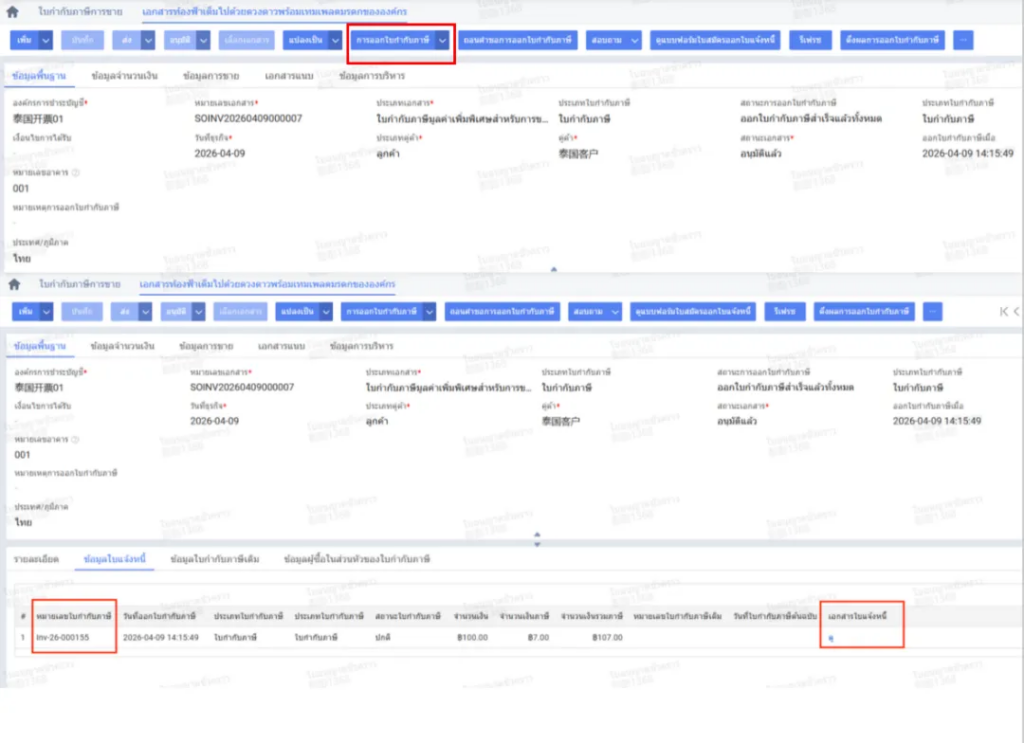
Kingdee AI Suite connects directly to the Thailand Revenue Department via local third-party invoice service providers, covering all scenarios including sales invoices, discount invoices and return invoices. Users can issue invoices with one click within Kingdee AI Suite without system switching, ensuring full consistency between business documents and invoice data. Invoicing information is automatically synchronized to the tax bureau, and invoiced data is sent back to ERP in real time to generate invoice records, forming a closed “issue-upload-archive” loop that significantly improves invoicing efficiency and shortens processing time.
3. Preconfigured Local Transaction Tax Rules, End-to-End Automated Tax Calculation & Filing
The tax engine of Kingdee AI Suite enables an end-to-end automated flow from business data to transaction tax calculation and tax filing. It automatically extracts full business data from accounts receivable/payable, payments, goods receipts and issues, and accurately calculates tax amount through three steps: tax element conversion, rule matching and tax computation. It automatically generates standard VAT, CIT and WHT filing forms fully aligned with official formats, eliminating manual entry and preventing errors or omissions.
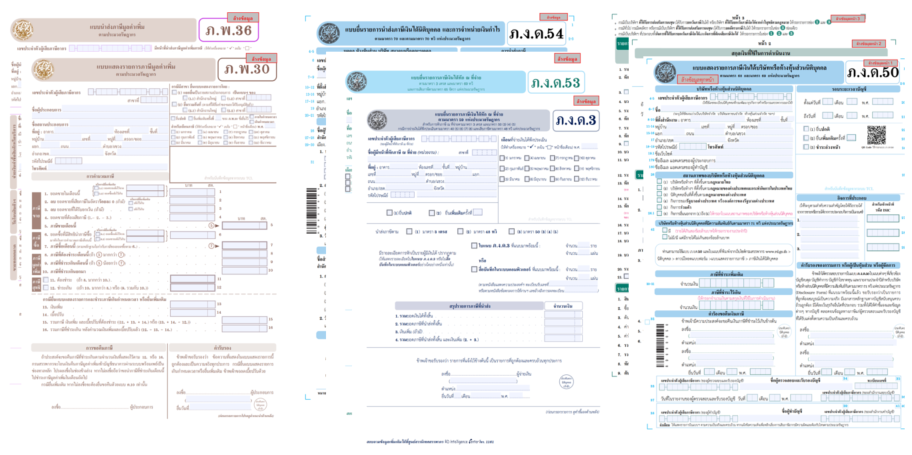
* Illustration: Multi-country tax & financial filing templates
Conclusion
Amid the full digitalization of Thailand’s fiscal and tax supervision, enterprise compliance capability has become a core competitiveness for global expansion. Rooted in local capabilities and powered by AI technology, Kingdee LocalKits Finance & Tax(Thailand) integrates financial accounting, e-invoice management and multi-tax filing in one stop. It replaces manual operations with automation and strengthens compliance through digitalization, allowing enterprises to focus on core business growth and ASEAN market expansion, and building solid confidence for their global journey.